
Artificial Intelligence is beginning to be incorporated into everyday life. Be it a chatbot answering customer queries or virtual assistants scheduling tasks for us, AI is everywhere today, and as these systems grow smarter, a new question begins to emerge: Can AI be emotionally intelligent? And if it can, how far does that capability truly go?
And that topic becomes even more vital when industries are incorporating emotional AI into customer service, healthcare, education-even in entertainment. But can machines truly feel emotions, or are they just copying those emotions? Let’s break this down in a simple, engaging way.
But what is emotional intelligence, precisely?
Emotional intelligence refers to the capacity to accurately recognize and comprehend emotional states in oneself and others, and respond appropriately to emotions in yourself and others. For humans, this skill comes naturally
We read facial expressions, recognize tone, sense moods, and adjust our responses.
But to machines, this is unnatural; it needs programming, training, and learning through data.
What Is Emotional AI?
Emotional AI includes technologies that can recognize, interpret, and react appropriately to human emotions..
They analyze data including :
- Voice tone
- Facial expressions
- Word choice
- Body Language
- Behavioral patterns
By analyzing these signals, emotional AI tries to understand how a person feels and responds in a way that appears empathetic.
Examples include:
- Chatbots that can detect frustration and offer assistance
- Cars that can detect driver stress
- Virtual therapists that analyze voice emotions
- Apps that track mood through facial expressions
But does this mean AI feels anything? Let’s explore.
Is AI Capable of Feeling Emotions?
The short answer is no-at least not in the human sense.
AI does not have a heart, memories, or personal experiences. We humans understand emotions because we live them; machines understand them because they measure them.
AI can:
- Recognize emotions
- Predicting emotional states
- Response with empathy-like language.
- Adjust behavior according to mood signals.
AI cannot :
- Feel happy or sad
- Understand emotional pain
- Experience love, fear, or trust
- Form emotional memories
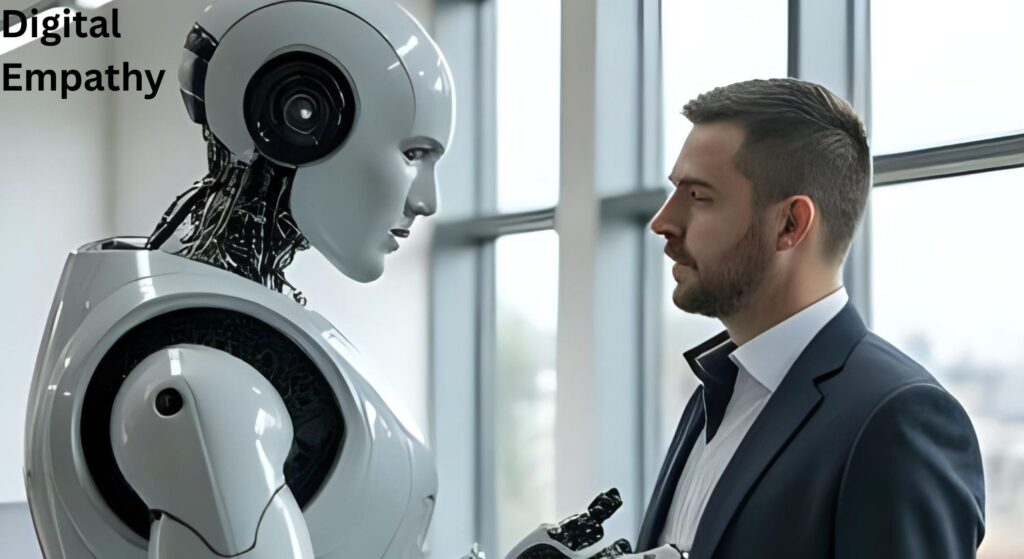
So, while AI can mimic empathy, it cannot truly feel empathy.
How Does AI Detect Emotions?
AI interprets human emotions with the help of several advanced technologies:
1. Natural Language Processing (NLP)
NLP examines words, tone, pace, and sentence patterns to detect emotion in a person’s voice or text.
2. Computer Vision
Computer vision analyzes facial muscles, eye movements, and expressions through cameras and image-processing techniques.
3. Machine Learning Models
Models are trained with millions of datasets to learn patterns of emotions.
For example, they can spot whether the customer sounds upset based on thousands of similar examples.
4. Behavioral Analytics
Mood can be comprehended by AI, which may track touch pressure on screens, typing speed, or browsing behavior.
While these methods are powerful, they only approximate emotions, not feel them.
Why Do We Want Machines to Be Emotionally Intelligent?
There are many reasons industries are adopting emotional AI:
1. Improved Customer Service
Bots that detect anger or confusion respond more quickly and accurately.
2. Better Health
AI can support mental health apps with early detecting stress, anxiety, or depression.
3. More Interactive Learning
AI Tutors adjust teaching style according to the frustration or confidence of the student.
4. Safer Transportation
In this regard, cars can identify whether a driver is distracted or sleepy and alert him or her instantly.
5. Personalized Entertainment
Games and apps can adjust to a user’s mood, making the experience more interactive and engaging.
Emotional AI can create more natural, human-like interactions but it should be handled responsibly.
Limits of Machine Empathy
Even as emotional AI gains more advanced features, several of its limitations persist.
1. AI Does Not Understand Context Fully
Human understanding comes from culture, life experiences, and instinct.
AI’s understanding comes only from the data it has been trained on
So it might misinterpret:
- Sarcasm
- Cultural expressions
- Complex emotional situations
- Mixed emotions
2. Emotions are not universal
Different people show emotions in different ways.
AI often struggles outside trained datasets.
3. Privacy Concerns
AI needs voice, video, and biometric data to grasp the emotions.
This raises some major ethical questions.
4. Risk of Over-Attachment
If a machine responds with perfect sympathy, humans may feel emotionally attached.
This may be consoling, but also misleading.
5. Lack of Empathy
I can produce responses such as “I understand how you’re feeling,” yet it has no real emotional experience.
This creates a disconnect between emotional expression and emotional experience.
Is emotional AI good or bad?
Like all technologies, emotional AI has its own benefits and risks.
Benefits :
- More supportive digital interactions
- Recognizing the early signs of emotional distress
- Personalized user experiences
- Improved customer satisfaction
- Improved accessibility for people with disabilities
Risks :
- Emotional manipulation
- Misreading human behavior
- Bias in Emotion Recognition Data
- Loss of human touch in emotional spaces
- Over-reliance on machine empathy
The key to emotional AI is using it responsibly, with strong guidelines on ethics.
The Future of Emotional AI: What Lies Ahead?
We are still at the early stages of AI in understanding human emotions.
In the future, emotional AI might:
- Become more valid across cultures
- Provide real-time emotional support within applications.
- Improve mental health monitoring
- Create more natural conversational experiences
- Support brands in developing stronger connections with their customers
One thing, however, is unlikely to change:
AI will simulate emotions but not feel them.
True emotion comes from human experiences-joy, pain, memories, relationships-not from algorithms.
So, Can AI Really Be Emotionally Intelligent?
AI is able to detect emotions, process them, and respond in helpful ways.
- It can seem empathetic.
- It can act supportive.
- It can understand what’s your mood.
But it cannot experience emotion.
The real power of emotional AI is not about replacing human empathy, but in augmenting human interaction, supporting mental well-being, and improving digital experiences.
Emotional AI can become a powerful tool, but only as long as we understand its limits. It’s one that helps machines understand us a little better, even if they never feel what we feel. Ultimately, emotional AI works best when paired with genuine human connection, not as a replacement for it.
Appreciate you being here! I’ll return soon with more fresh perspectives on how technology continues to shape our world. Until then, stay curious, keep learning, and never stop evolving!”
For more exciting blogs do visit us on :- https://prabneksingh.com/blog/